
A Somatic Practice for When Grief Feels Too Big
Your Friday tool - something simple your body can lean on.

Grief doesn’t just live in the mind. It pulls at the nervous system, curls the shoulders inward, tightens the jaw, and settles into the chest like a weight you can’t quite shift. When loss is fresh - or even when it’s years old but still tender - the body often reacts before we understand why we’re suddenly overwhelmed.
Today’s tool is a simple grounding practice to help your body feel held instead of braced. It’s something I return to often, especially on the days when the ache shows up without warning.
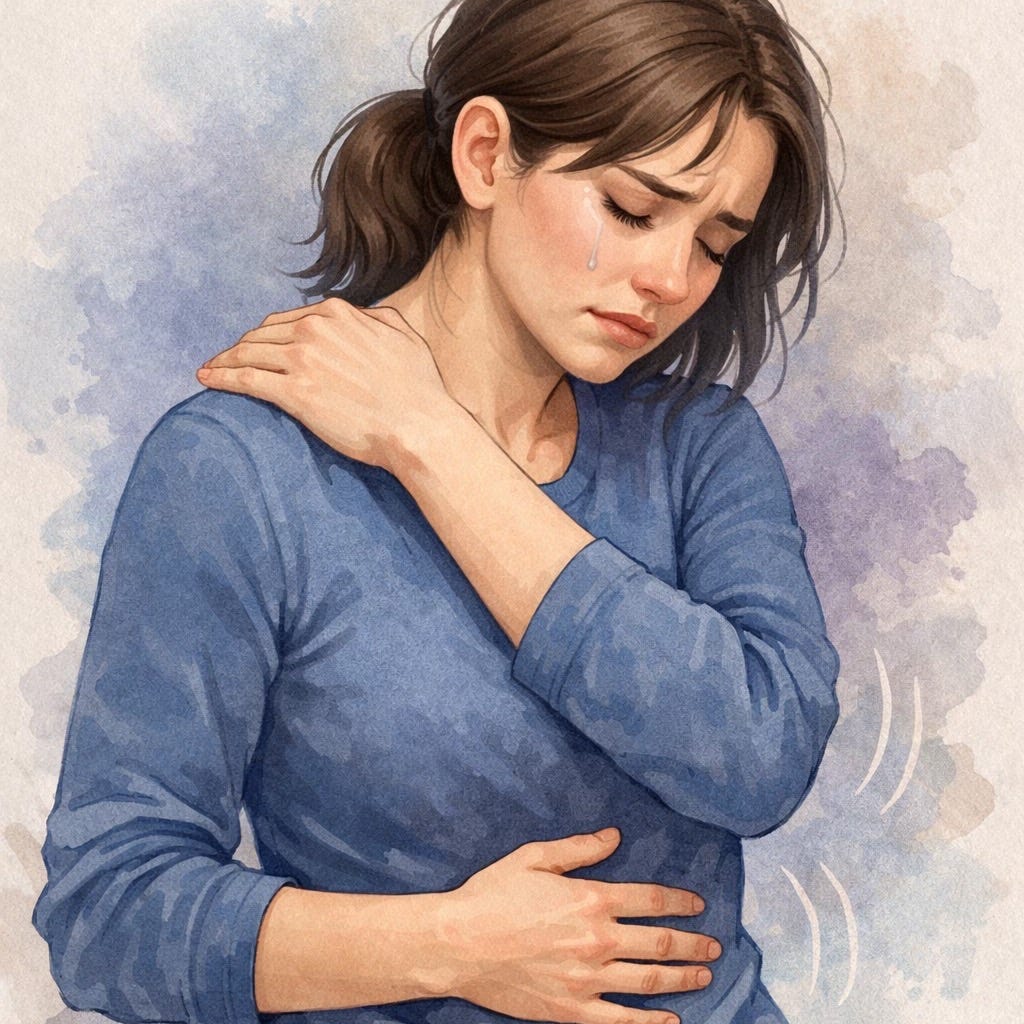
The 3-Point Touch
This practice works by giving your body clear signals of safety and containment - something grief can make hard to access.
1. Hand to Heart
Place one hand over your heart. Let your shoulders drop a little. Feel the warmth of your palm meeting your heartbeat. You don’t have to slow your breath. Just notice that you’re here.
2. Hand to Belly
Rest your other hand on your belly. Grief tends to make our breath shallow; this helps make space for it again. Let your breath meet your hand, even if it’s small.
3. One Hand to the upper Back
Gently slide the hand previously on your heart to your upper back, like you’re patting yourself on the back.
This shift tells the body, “You’re not collapsing. You’re being held.”
Stay here for 30–60 seconds.
You don’t have to feel calm for it to “work.”
The purpose is simply to remind your nervous system that it has support.
Grief changes the body.
This practice gives it a place to land.
If you need more gentle tools, I’ve gathered everything - book recommendations, soothing products, my grief resources, and the supports I personally use - inside my Linktree here: Tools-Resources-More support. It’s always there when you need a bigger toolbox.
Warmly,
Jamie
Love this! Clear, practical, and it demystifies why breathwork isn’t “woo”, it’s physiology! From a clinician lens, the key insight is that breathing is one of the few levers we can consciously pull on the autonomic system: a slow diaphragmatic inhale + longer exhale tends to increase vagal (parasympathetic) signaling, improve baroreflex sensitivity, and downshift threat arousal, often enough to show up as a measurable drop in HR/BP in real time. Your “4–8” style cue is a great on-ramp because it’s simple and immediately reinforcing.
Two practical add-ons I often tell patients:
1. Treat it like a micro-dose you can repeat: 3–5 cycles before a difficult email/meeting, after exercise, or as a “sleep on-ramp.”
2. Keep it comfortable (no straining/air hunger). If someone gets lightheaded or panicky, shorten the exhale slightly and build gradually.
And I appreciate the framing: this isn’t a replacement for treating hypertension/anxiety when indicated, but it’s one of the highest ROI, lowest-risk tools we have for daily stress physiology.
Thank you, Jamie. This simple practice feels like a gentle hug for the body and soul.